Low-Bid Epoxy Quotes in Tampa: What You're Actually Paying For—and What You're Not
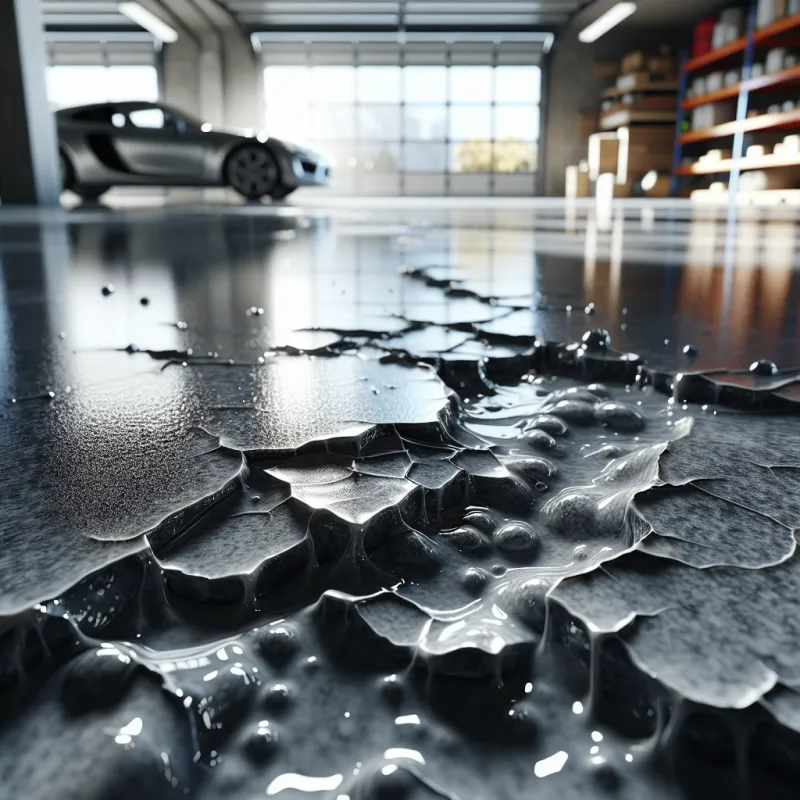
Photo: peeling epoxy floor garage delamination concrete surface failure, via backend.juice.ai
There is a version of this story that plays out regularly in garages, warehouses, and commercial facilities across the Tampa Bay area. A property owner receives three or four quotes for epoxy flooring. One comes in noticeably lower than the others. The work gets scheduled, the crew arrives, finishes in a few hours, and the floor looks fine—for a while. Then, somewhere between six months and two years later, the coating begins to peel, bubble, or flake in sheets. The owner calls the contractor. The warranty, if one was offered at all, has expired or contains exclusions broad enough to cover virtually any failure mode.
At that point, the floor has to be stripped and redone. The total cost—original installation plus remediation plus any business disruption or property inconvenience—now substantially exceeds what a quality contractor would have charged from the start.
This pattern is not accidental. It is the predictable outcome of specific shortcuts, and understanding those shortcuts is the most effective way to avoid them.
Why Some Epoxy Quotes Are So Much Lower
Epoxy flooring is not a commodity service where all providers are delivering the same product at different margins. The price differential between a low-bid contractor and a reputable one almost always reflects genuine differences in what is being done—not superior efficiency or lower overhead.
The three primary areas where corners get cut are surface preparation, material quality, and application process. Each of these contributes to the final price in ways that are not always visible in a written quote, and each has direct consequences for how long the finished floor will perform.
The Surface Preparation Problem
Ask any experienced epoxy contractor what causes the majority of coating failures, and the answer will be consistent: inadequate surface preparation. Epoxy does not adhere to a smooth, contaminated, or structurally compromised concrete surface. It requires a mechanical profile—a roughened texture achieved through diamond grinding or shot blasting—that allows the coating to bond at a molecular level with the substrate.
Professional surface preparation requires specialized equipment, trained operators, and time. A crew using rental-grade equipment or skipping the grinding process entirely can complete a job in a fraction of the time it takes to do it correctly. That time savings translates directly into a lower quote—and directly into a coating that will delaminate.
In Tampa specifically, surface preparation also involves moisture assessment. Florida's water table and the thermal cycling common to Gulf Coast climates mean that moisture vapor transmission through concrete slabs is a documented and measurable risk. A contractor who skips moisture testing and the application of a vapor-barrier primer is gambling with your floor's longevity. When moisture migrates through the slab and encounters an impermeable coating from below, the result is bubbling, blistering, and eventual delamination—regardless of how well the coating itself was applied.
Premier Epoxy Tampa has assessed and remediated numerous floors in the greater Tampa area where the original contractor's failure to address moisture was the sole cause of a coating that failed within its first year.
Material Quality: What's Actually in That Bucket
Not all epoxy is equivalent. The formulation—specifically the solids content, the resin-to-hardener ratio, and the quality of the base components—determines how the coating performs under traffic, chemical exposure, and UV light.
Low-cost contractors frequently use water-based or low-solids epoxy products that are significantly cheaper to purchase than the 100% solids systems used in professional commercial and residential applications. These products are thinner, cure differently, and produce a dry film thickness that may be a fraction of what a high-solids system delivers. Dry film thickness is not an abstract specification—it directly correlates with abrasion resistance, impact resistance, and the coating's ability to bridge minor substrate imperfections.
Beyond the base epoxy, the topcoat selection matters considerably. In Tampa's climate, UV exposure is a constant factor for any floor near windows, glass doors, or exterior-adjacent spaces. Standard epoxy topcoats will amber and chalk under UV exposure. A quality contractor specifies a polyaspartic or aliphatic urethane topcoat for applications where UV resistance is relevant. A budget contractor often skips this step, and the floor's appearance degrades accordingly.
When reviewing quotes, ask each contractor specifically what products they are installing—by brand and product line—and look those products up. The difference between a professional-grade system and a contractor-supply-house budget product is often visible in the published technical data sheets.
Application Shortcuts That Don't Show Up Until Later
Beyond preparation and materials, the application process itself offers multiple opportunities for shortcuts that are invisible at the time of installation but become apparent within months.
Mixing ratios matter precisely. Epoxy is a two-component system, and the ratio of Part A to Part B must be exact for the chemistry to complete correctly. A crew working quickly under time pressure may mix by approximation rather than by measured weight or volume. An improperly catalyzed epoxy may cure to a surface that appears normal but remains chemically soft, leading to premature wear, scuffing, and surface degradation under normal use.
Coat thickness and cure time between coats are equally important. Each layer of a multi-coat system must reach an appropriate cure stage before the next layer is applied. Rushing this process—particularly in Tampa's humidity, which affects cure rates—can result in intercoat adhesion failures that manifest as delamination between layers rather than between the coating and the substrate.
Finally, the broadcast aggregate application in decorative or anti-slip systems requires a consistent hand and appropriate coverage rates. Uneven broadcast creates visual inconsistencies and, more importantly, inconsistent slip resistance—a safety and liability concern in commercial applications.
A Framework for Evaluating Contractor Quality
Given that these shortcuts are not always visible in a written quote, how should Tampa property owners assess the quality of a contractor before committing?
Request a written scope of work. A reputable contractor will document the preparation method (specifying diamond grinding or shot blasting and the target surface profile), the products being installed (by name and product line), the number of coats and approximate dry film thickness, and any moisture mitigation measures. Vague language like "prep and coat" is a warning sign.
Ask for references from completed projects of similar scope. Residential garage references are not equivalent to commercial warehouse references. Ask to speak with clients whose projects are at least 18 months old—this is long enough for early failures to have manifested.
Verify insurance and licensing. Florida requires contractor licensing, and a legitimate epoxy contractor should carry both general liability insurance and workers' compensation coverage. Ask for certificates, not assurances.
Evaluate the quote structure, not just the total. A detailed quote that breaks out preparation, materials, labor, and warranty terms is more informative than a single line-item number. If a contractor cannot or will not itemize their quote, that opacity itself is meaningful.
Understand the warranty terms precisely. A warranty that excludes failure due to moisture, improper use, or normal wear covers very little. Ask what the warranty actually covers, what the claims process involves, and whether the contractor has the business longevity to honor it.
The True Cost Calculation
A quality epoxy installation in Tampa, performed with proper preparation, professional-grade materials, and appropriate application technique, should perform reliably for a decade or more under normal conditions. A budget installation that fails within two years and requires full remediation—including the cost of stripping the failed coating, re-preparing the substrate, and reinstalling—will cost more in total than the quality installation would have cost originally, often by a significant margin.
The lowest number on a quote sheet is not the cost of getting a floor done. It is the cost of getting a floor done once—with no guarantee of how long that single attempt will last.
Premier Epoxy Tampa provides detailed written scopes of work, transparent product specifications, and warranties that reflect confidence in the systems we install. We encourage every property owner in the Tampa Bay area to bring our quotes into direct comparison with any other they receive—and to ask the same questions of every contractor on their list.