What DIY Epoxy Really Costs Tampa Homeowners: Mistakes, Failures, and the Fix
Walk through any home improvement store in the Tampa Bay area and you will find epoxy floor coating kits stacked near the checkout lane, promising a showroom-worthy garage floor for a few hundred dollars and a weekend afternoon. The appeal is understandable. The packaging looks professional, the before-and-after images are compelling, and the price point is a fraction of what a licensed contractor would charge.
The problem is that those kits are designed for simplicity, not for durability—and Florida's environment is anything but forgiving. At Premier Epoxy Tampa, we receive calls nearly every week from homeowners who attempted a DIY installation and are now living with a floor that is peeling, clouding, or separating from the concrete beneath it. What follows is an honest account of what goes wrong, why it happens, and what it actually takes to correct it.
Why DIY Epoxy Seems Like a Reasonable Idea
Before assigning any blame, it is worth acknowledging that the impulse to self-install is entirely rational. Epoxy flooring, on the surface, appears straightforward: clean the floor, apply the coating, let it cure. Online tutorials make the process look achievable in an afternoon, and consumer-grade kits have improved in recent years. For someone on a tight budget, saving a thousand dollars or more is a legitimate motivation.
The gap between a successful DIY project and a failed one, however, almost always comes down to preparation, chemistry, and environmental control—three variables that are far more complex than any kit's instruction sheet can fully address.
The Most Common Failure Point: Surface Preparation
In our experience, inadequate surface preparation accounts for the majority of DIY epoxy failures. Concrete is a porous material, and for epoxy to bond correctly, the surface must be mechanically profiled—meaning it needs a texture that allows the coating to grip the slab rather than simply sit on top of it.
Most homeowners clean their concrete with a degreaser and consider that sufficient. It is not. Professional installations require either diamond grinding or acid etching to open the pores of the concrete and remove any existing sealers, oils, or curing compounds. Skipping this step is the single most reliable way to guarantee a coating that peels within months.
We recently completed a corrective project in New Tampa where a homeowner had applied a store-bought kit over a garage floor that had been sealed years earlier. The coating had lifted in sheets within eight weeks. Removing it required grinding the entire surface down, a process that added both time and expense that the original DIY approach was supposed to avoid.
Mixing Ratios and Pot Life: The Chemistry Problem
Epoxy is a two-part system. The resin and the hardener must be combined in precise ratios and worked within a specific window of time—known as pot life—before the mixture begins to set. Consumer kits simplify this by packaging components in pre-measured containers, but that simplification introduces its own risks.
Temperature has a dramatic effect on pot life. In Tampa, where garage temperatures can climb above 90 degrees Fahrenheit during summer months, the working time for a mixed batch can shrink significantly. Homeowners who are moving at a comfortable pace may find that their coating has already begun to gel before they finish the application, resulting in an uneven surface with visible texture variations.
We have also seen cases where partial batches were mixed—homeowners trying to manage smaller sections—leading to inconsistent film thickness and curing irregularities across the floor. These issues are difficult to correct without removing the entire coating and starting over.
Application Errors and Their Visual Consequences
Even when surface prep is adequate and mixing ratios are correct, application technique matters. Roller nap selection, back-rolling timing, and broadcast aggregate distribution all influence the final appearance and performance of the floor.
Bubbling is one of the most common complaints we hear. This occurs when air trapped in the concrete or in the mixed coating rises to the surface before the epoxy has time to self-level. Professional installers use spike rollers and control application speed to minimize this, but the technique takes practice. A first-time installer working under time pressure is unlikely to achieve the same result.
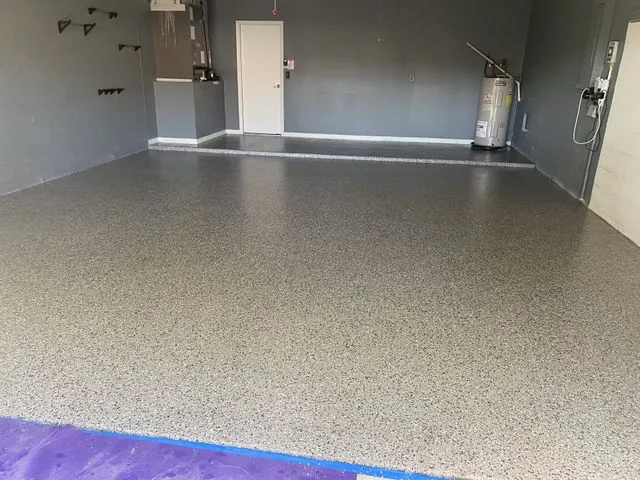
Decorative flake systems—the multi-colored chip broadcasts that have become popular in residential garages—require a specific broadcast technique to achieve full coverage. Applied too sparingly or unevenly, the result is a patchy floor with visible bare spots. Applied too heavily without proper backcoating, the chips may not adhere correctly.
The Real Cost of Correction
This is where the economics of DIY epoxy become unfavorable in a way that is worth stating plainly. A corrective installation is almost always more expensive than a first-time professional installation would have been.
Removing a failed DIY coating requires grinding or shot blasting. If the original coating was applied over moisture-compromised concrete, the slab may require additional remediation before a new coating can be installed. The labor involved in corrective work is substantial, and in some cases, the timeline extends several days to allow for proper moisture testing and surface stabilization.
The homeowners we work with on corrective projects are universally candid about the math: the DIY kit cost a few hundred dollars, the failed installation cost them a weekend, and the professional correction cost more than a professional installation would have from the beginning.
When DIY Makes Sense—and When It Does Not
We are not suggesting that homeowners should never attempt their own projects. For low-traffic areas with minimal moisture exposure and modest aesthetic expectations, a quality consumer kit applied by a careful, patient installer can produce acceptable results. The key word is realistic: the outcome will reflect the materials and process used.
For garage floors, commercial spaces, pool decks, or any surface exposed to Florida's humidity and temperature extremes, professional installation is a genuinely better investment—not because contractors want the business, but because the technical demands of a durable installation in this climate exceed what a one-time installer can reliably achieve.
If you are weighing the decision, we encourage you to contact us for a consultation before purchasing a kit. In many cases, we can walk you through what your specific floor requires and give you an honest assessment of whether a professional installation makes financial sense for your situation. That conversation costs nothing, and it may save you considerably more than the price of a weekend project.