Why Tampa's Food Service Industry Is Turning to Epoxy: Compliance, Cleanliness, and Commercial Durability
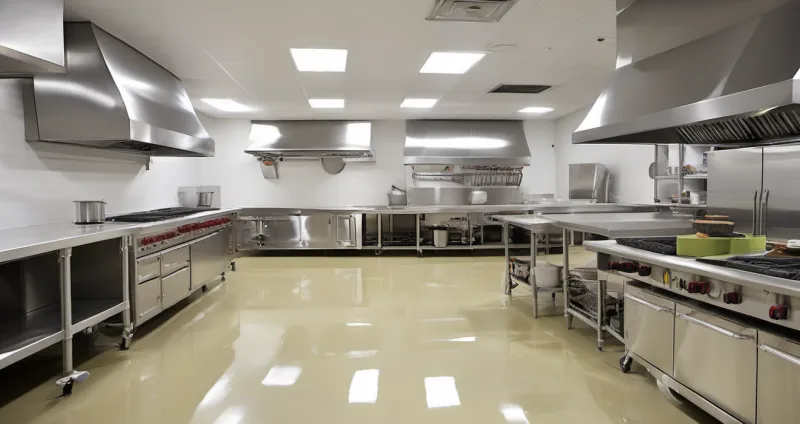
Photo: commercial kitchen epoxy floor restaurant stainless steel equipment Tampa, via www.epoxyflooringraleigh.com
Running a food service operation in Tampa means navigating a demanding intersection of state health regulations, high-traffic wear, and the relentless humidity that defines Florida's Gulf Coast climate. The floor beneath a commercial kitchen is not merely a surface to walk on—it is a regulated component of your facility, subject to inspection and capable of either protecting or jeopardizing your operating license.
Epoxy flooring has become the material of choice for Tampa restaurants, institutional kitchens, food processing facilities, and catering operations precisely because it addresses each of these pressures simultaneously. Understanding why requires a closer look at what health codes actually demand, how epoxy performs under the conditions common to commercial kitchens, and what real Tampa establishments have experienced after installation.
What Florida Health Codes Actually Require From Commercial Floors
The Florida Department of Business and Professional Regulation, alongside Hillsborough County's Environmental Protection Commission, mandates that food service floors be smooth, nonabsorbent, easily cleanable, and resistant to the chemicals used in routine sanitation. Grout lines, porous tile surfaces, and cracked concrete all create conditions where food particles, grease, and bacteria can accumulate beyond the reach of standard mopping.
The FDA Food Code—which Florida adopts as its baseline standard—specifically addresses flooring in sections governing physical facilities. Inspectors look for surfaces that do not harbor contaminants, that can withstand wet cleaning and chemical disinfection, and that maintain their integrity under the thermal cycling caused by steam, hot water, and cold storage proximity.
Bare concrete fails these requirements on multiple counts. It is inherently porous, prone to cracking, and absorbs grease and moisture over time. Ceramic tile, while nonabsorbent at the surface, introduces grout lines that are notoriously difficult to keep sanitary. Epoxy, applied correctly over properly prepared concrete, creates a monolithic surface with no seams, no grout, and no pathways for contamination to take hold.
The Sanitation Advantage of Seamless Surfaces
The phrase "seamless surface" carries genuine technical weight in a food service context. When a kitchen floor has no joints, cracks, or transitions between materials, cleaning staff can move a mop or squeegee from one end of the space to the other without debris accumulating at edges or grout lines. Chemical sanitizers make full contact with the entire floor rather than pooling in recessed areas.
High-solids epoxy systems, which Premier Epoxy Tampa uses in commercial kitchen applications, also resist the chemical aggression of common kitchen sanitizers, degreasers, and enzymatic cleaners. Many lower-grade coatings degrade under repeated exposure to these substances, leading to surface breakdown and renewed porosity. Properly formulated commercial epoxy maintains its chemical resistance over years of daily cleaning cycles.
Beyond chemistry, the nonporous surface prevents the growth of mold and mildew—a significant concern in Tampa's humid environment, where moisture intrusion through concrete slabs is a documented risk. A sealed, properly installed epoxy system creates a barrier that manages this moisture dynamic far more effectively than untreated concrete or tile with compromised grout.
Slip Resistance: A Regulatory and Liability Requirement
A common misconception holds that epoxy floors are inherently slippery, particularly when wet. This concern is legitimate when discussing decorative residential epoxy with a high-gloss finish, but it does not apply to properly specified commercial kitchen flooring.
For food service environments, Premier Epoxy Tampa applies broadcast aggregate systems—typically aluminum oxide or quartz broadcast into the topcoat—that produce a textured surface meeting or exceeding the OSHA-recommended coefficient of friction for wet environments. These surfaces are specifically engineered for the grease-laden, water-present conditions of active kitchens.
Hillsborough County health inspectors and OSHA compliance officers both evaluate slip resistance as part of their assessments. Selecting a flooring contractor who understands the appropriate aggregate broadcast rates and topcoat formulations for food service applications is not optional—it is a liability management decision with direct consequences for your staff and your business.
Case Study: A South Tampa Restaurant Renovation
A full-service restaurant in South Tampa approached Premier Epoxy Tampa following a health inspection that cited their existing quarry tile floor for deteriorating grout and evidence of bacterial accumulation near the prep stations. The kitchen footprint covered approximately 1,400 square feet, including a walk-in cooler transition zone and a dishwashing area subject to constant moisture.
The existing tile was removed, the concrete substrate was ground and profiled to ICRI CSP 3 standards, and a moisture-mitigation primer was applied given the slab's proximity to Tampa's water table. The installation consisted of a 100% solids epoxy base coat, a broadcast quartz aggregate layer, and a urethane topcoat selected for its superior chemical and thermal resistance relative to standard epoxy topcoats.
The facility passed its subsequent health inspection without citations related to flooring. Kitchen staff reported a measurable reduction in cleaning time, and the owner noted that the floor's reflective quality improved ambient lighting in a space that had previously relied on supplemental fixtures.
Case Study: A Catering Facility in Ybor City
A catering operation in the Ybor City corridor required flooring that could accommodate both food production and event staging, with frequent transitions between heavy rolling equipment and foot traffic from clients touring the space. The previous vinyl composite tile had buckled in multiple locations due to moisture beneath the slab and the thermal expansion common to Tampa's climate.
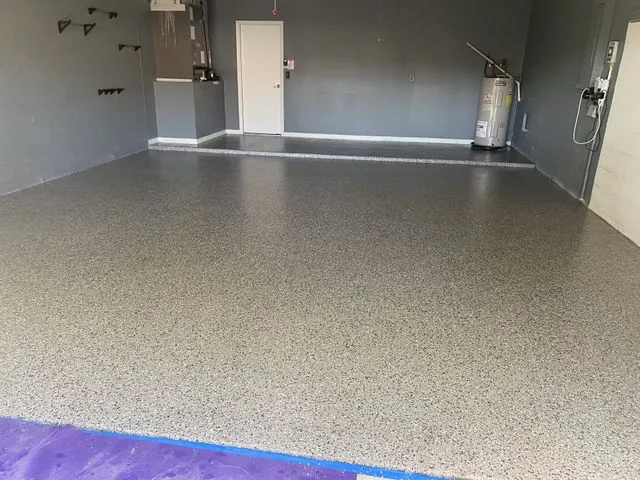
Premier Epoxy Tampa installed a decorative flake system with a commercial-grade urethane topcoat, providing the aesthetic quality appropriate for client-facing areas while maintaining the slip resistance and chemical resistance required for production zones. The system accommodated the facility's dual-purpose use without requiring different flooring products across different areas—a significant advantage for cleaning protocol consistency.
Design Considerations That Don't Compromise Function
Food service operators sometimes assume that regulatory compliance and visual appeal are mutually exclusive. In practice, modern epoxy systems offer substantial design flexibility without sacrificing performance. Color coding of different kitchen zones—a practice supported by food safety protocols—is easily achieved through epoxy. Safety markings, directional indicators, and equipment placement guides can all be integrated into the floor itself during installation.
For establishments where the kitchen is partially visible to guests, the floor's appearance contributes to the overall impression of cleanliness and professionalism. A well-maintained epoxy surface communicates operational standards in a way that stained concrete or cracked tile cannot.
Selecting the Right Contractor for Food Service Epoxy
Not every epoxy contractor has experience with the specific requirements of food service environments. The correct product selection, substrate preparation standards, and application sequencing for a commercial kitchen differ meaningfully from those appropriate for a residential garage. Contractors unfamiliar with FDA Food Code requirements or local health department inspection criteria may install a system that looks adequate but fails compliance review.
Premier Epoxy Tampa works directly with facility managers, general contractors, and restaurant owners throughout the greater Tampa Bay area to specify systems that meet both regulatory requirements and operational demands. Every commercial kitchen project begins with a substrate assessment, a moisture evaluation, and a detailed review of the facility's cleaning and chemical protocols before a product recommendation is made.
For Tampa food service operators evaluating their flooring options, the question is not whether epoxy meets the standard—it consistently does. The question is whether the contractor installing it understands the specific demands of your environment well enough to select and apply it correctly.