The Landlord's Flooring Equation: How Tampa Property Managers Are Using Epoxy to Reduce Turnover Costs and Boost Asset Value
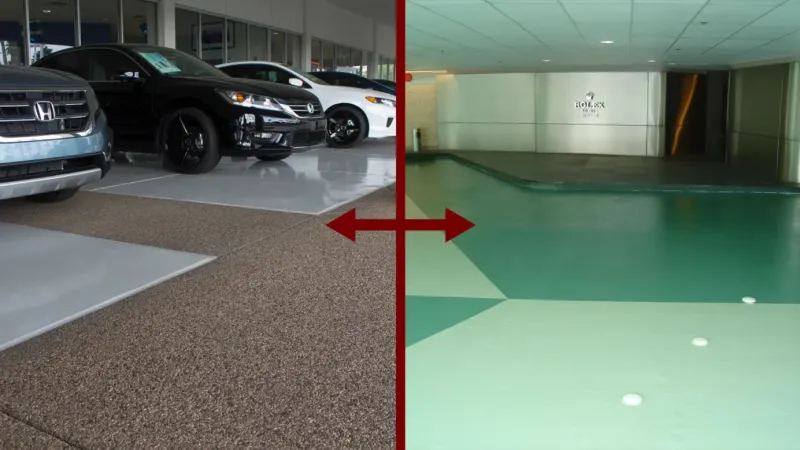
Photo: epoxy floor apartment complex parking garage common area commercial property, via garagefloorcoatingofnashville.com
For property managers overseeing multi-unit residential buildings in Tampa, flooring decisions are rarely about aesthetics alone. Every square foot of floor in a common area, parking garage, laundry facility, or utility corridor is a maintenance liability—something that will stain, crack, chip, or absorb moisture and eventually require attention. The question is not whether the floor will need maintenance, but how frequently and at what cost.
A growing number of Tampa-area landlords and property management companies have reached the same conclusion: epoxy flooring in high-traffic, high-exposure spaces is not a premium upgrade—it is a cost-control strategy.
The Maintenance Problem With Conventional Flooring in Rental Properties
Bare concrete is the default choice in many multi-unit common areas because it is inexpensive to install. In practice, however, uncoated concrete in a rental environment carries ongoing costs that compound over time. It dusts, stains, and absorbs spills permanently. Bicycle tires leave marks. Automotive fluids from residents' vehicles seep into the slab. Moisture migration from Tampa's water table causes efflorescence and surface deterioration.
Vinyl composition tile (VCT), another common choice in corridors and laundry rooms, requires periodic waxing and buffing to maintain its appearance, and individual tiles crack or delaminate under heavy rolling loads. Sheet vinyl performs better in wet environments but is vulnerable to tears and lifting at seams—particularly in spaces where carts, dollies, and maintenance equipment are in regular use.
Each of these failure modes translates directly into labor hours, material costs, and tenant dissatisfaction. In a competitive Tampa rental market where tenant retention is a measurable financial variable, flooring condition has more influence on renewal decisions than many property managers initially assume.
Why Epoxy Changes the Maintenance Calculus
A properly installed epoxy system in a common area or parking structure creates a seamless, non-porous surface that does not absorb stains, does not require waxing or periodic refinishing, and resists the mechanical abuse of everyday residential use. Maintenance is reduced to routine mopping with a pH-neutral cleaner—no specialized equipment, no scheduled professional service.
The durability advantage is particularly significant in Tampa's climate. The city's combination of high humidity, intense UV exposure, and frequent temperature fluctuation creates conditions that degrade many conventional flooring materials prematurely. Epoxy systems formulated with UV-stable topcoats and moisture-tolerant primers perform consistently in these conditions over periods of ten to twenty years when properly maintained.
For property managers tracking cost-per-square-foot annually, the difference between epoxy and alternatives becomes apparent within the first two to three years of ownership.
Case Study: A Seminole Heights Apartment Complex
A property management firm overseeing a 48-unit apartment complex in Seminole Heights contacted Premier Epoxy Tampa after spending approximately $14,000 over three years on VCT maintenance, replacement, and stain remediation in the building's two common corridors and ground-floor laundry room.
The scope of the epoxy project covered approximately 2,800 square feet of corridor and utility space. Surface preparation included shot blasting to remove the existing VCT adhesive residue and a full moisture assessment—a critical step given the building's slab-on-grade construction.
The installed system was a broadcast vinyl flake epoxy with a polyaspartic topcoat, chosen for its slip resistance (an important liability consideration in common areas), ease of cleaning, and visual consistency across all three spaces. Total project cost was $18,400.
In the two years following installation, the property management firm reported zero reactive maintenance expenditures on those surfaces. Routine cleaning was performed by existing janitorial staff with no change to their standard protocol. The annualized cost comparison—approximately $4,667 per year in the pre-epoxy period versus near zero in the post-installation period—placed the break-even point at roughly four years, with projected savings accelerating significantly beyond that threshold.
Parking Garages and Utility Spaces: The Highest-ROI Applications
Within multi-unit residential properties, parking garages and utility corridors represent the highest-return applications for epoxy flooring. These spaces experience concentrated mechanical stress—vehicle traffic, hydraulic fluid exposure, heavy equipment movement—combined with persistent moisture exposure from rain, vehicle wash-off, and condensation.
Uncoated concrete in a residential parking garage deteriorates in a predictable pattern: surface dusting begins within the first year, oil and fluid stains become permanent within two to three years, and surface spalling accelerates from there. Remediation of a deteriorated parking garage slab is significantly more expensive than preventive coating at the time of construction or early in the property's lifecycle.
A condominium association in New Tampa recently commissioned a full epoxy coating of their 14,000-square-foot parking structure after receiving a concrete restoration bid of $62,000 for spall repair and slab stabilization. The epoxy installation—which included crack injection, surface grinding, a moisture-mitigation primer, and a two-coat epoxy system with a polyaspartic topcoat—was completed for $41,000 and addressed the underlying surface deficiencies in the same scope of work. The association also negotiated a ten-year warranty on the coating system.
Tenant Satisfaction as a Quantifiable Variable
Property managers focused purely on cost-per-unit sometimes overlook the connection between physical asset condition and tenant retention. In Tampa's rental market, where vacancy rates and competition among properties are meaningful financial variables, the condition of common areas influences both initial leasing decisions and renewal rates.
Epoxy-coated common areas present consistently well. They do not stain visibly between cleanings, they resist the dingy appearance that bare concrete and worn VCT develop over time, and they communicate a standard of property upkeep that prospective tenants notice. Several property managers who have worked with Premier Epoxy Tampa have reported anecdotally that common-area renovations—including flooring upgrades—contributed to measurable improvements in lease renewal rates, though precise attribution is difficult to isolate from other variables.
Calculating ROI for Your Property
The return-on-investment calculation for epoxy flooring in a multi-unit residential context should account for the following variables:
- Current annual maintenance expenditure on the target surfaces (labor, materials, professional service calls)
- Projected replacement timeline for the existing flooring material without intervention
- Installed cost of the epoxy system
- Expected service life of the epoxy system under the specific use conditions
- Intangible factors such as liability reduction (slip resistance, elimination of trip hazards at tile seams) and tenant satisfaction impact
For most Tampa-area properties with moderate to high common-area traffic, the break-even point falls between three and six years, with meaningful net savings accumulating in years seven through twenty.
Working With a Contractor Who Understands Commercial-Scale Residential Projects
Not every epoxy contractor has experience with the logistical demands of multi-unit residential projects—coordinating access around tenant schedules, phasing work to maintain building functionality, and delivering consistent results across large, continuous surface areas.
At Premier Epoxy Tampa, we approach multi-unit residential projects with the same structured methodology we apply to commercial work: detailed pre-installation assessment, written project schedules, and documentation of all installed systems for property records. For property managers who need to demonstrate due diligence to HOA boards, ownership groups, or asset managers, that documentation has practical value beyond the floor itself.
The flooring decision you make today in a common area or parking structure will affect your maintenance budget, your tenant experience, and your asset's condition for the next decade or more. For Tampa landlords and property managers, epoxy is increasingly the decision that makes financial sense.