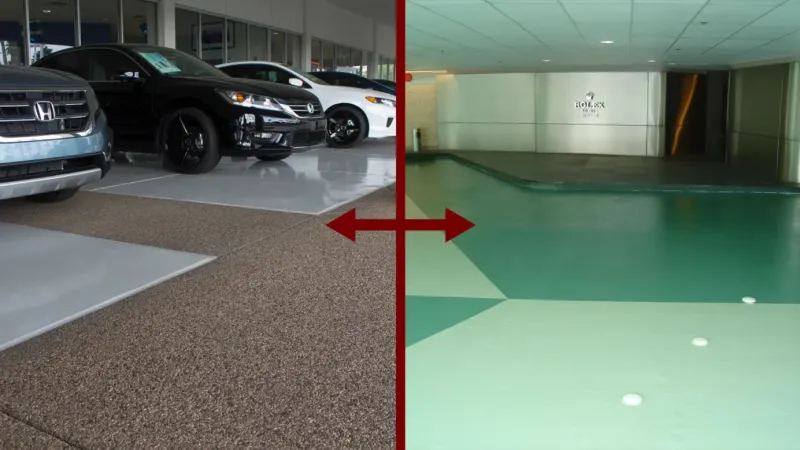
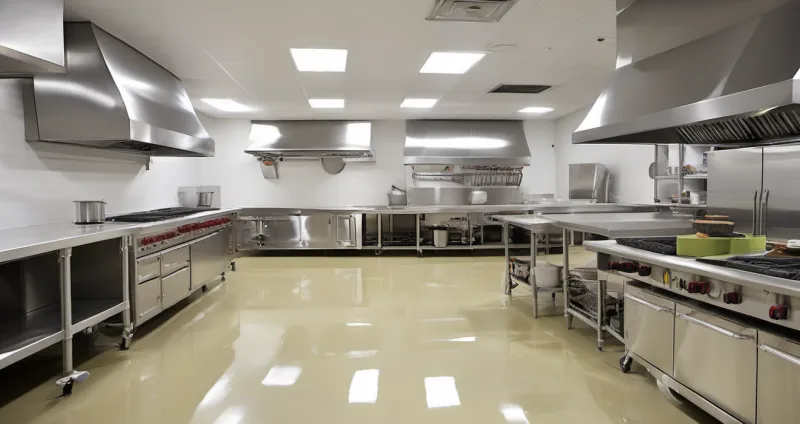
From Factory Floor to Living Room: How Epoxy Became Tampa's Most Versatile Design Statement
There was a time when specifying epoxy flooring in a residential setting required some explanation. The material carried the unmistakable associations of its industrial origins — utilitarian, gray, and relentlessly practical. That time has passed.
Across Tampa's newer construction neighborhoods and renovated mid-century properties alike, epoxy flooring is appearing in spaces where homeowners once defaulted to hardwood, large-format tile, or polished concrete. The shift is not accidental. It reflects a genuine convergence of material science advancement, evolving design sensibility, and a Tampa housing market that rewards distinctive, well-executed interiors.
The Design Evolution of a Technical Material
Understanding why epoxy has found a place in residential design requires a brief look at how the material itself has changed. Early commercial epoxy systems were formulated almost exclusively for performance: chemical resistance, impact tolerance, and ease of sanitation. Appearance was secondary, and the palette reflected that priority.
Modern epoxy systems — particularly those developed over the past decade — have been reformulated with aesthetic versatility as a design objective. Pigment suspension technology has improved dramatically, allowing colorists to achieve hues and gradients that would have been impossible to maintain in earlier formulations. The introduction of metallic powder additives created an entirely new category of finish: one that produces organic, fluid-appearing surfaces with depth and movement that no two installations replicate exactly.
This unpredictability, once considered a manufacturing defect, is now recognized as a design asset. Homeowners and their designers are drawn to the fact that a metallic epoxy floor is, in a meaningful sense, one of a kind.
Color Psychology and the Tampa Aesthetic
Tampa's built environment has always engaged in a dialogue with its natural surroundings — the bay, the subtropical light, the lush vegetation that frames so many residential properties. That context shapes how local designers approach color selection in interior spaces, including floors.
Cool-toned epoxy finishes in aqua, slate, and soft gray have found particular resonance in Tampa interiors, echoing the water-adjacent quality of life that defines much of the region's identity. Warmer tones — terracotta-adjacent neutrals, warm whites, and champagne metallics — perform well in homes with significant natural light exposure, where the floor becomes part of a reflective system that amplifies the brightness of the space.
Designers working on high-end residential projects in neighborhoods such as Hyde Park, Davis Islands, and Westchase have noted that clients are increasingly arriving to consultations with epoxy-specific references — images pulled from design publications and social media that show seamless, flowing floors as central elements of contemporary interiors rather than background surfaces.
What Local Designers Are Specifying
The integration of epoxy into upscale Tampa residential design has been facilitated in part by a closer working relationship between flooring contractors and interior design professionals. Where epoxy was once selected by homeowners independently of their design process, it is now frequently specified as part of a cohesive interior scheme.
Designers in the Tampa market have described epoxy as a material that rewards collaboration. The ability to custom-match floor colors to cabinetry, wall treatments, or furniture upholstery creates coordination opportunities that tile or hardwood cannot easily replicate. For open-plan spaces — which dominate contemporary Tampa home layouts — the seamless nature of an epoxy floor also provides a visual continuity that grout lines and plank transitions interrupt.
Some designers have begun incorporating epoxy in unexpected applications: feature walls in home offices, custom-finished bathroom floors in wet areas where slip-resistant additives are incorporated into the topcoat, and covered lanai surfaces that bridge the visual gap between interior and exterior living spaces.
Customization Options: A Technical Overview
For homeowners approaching epoxy as a design choice rather than a purely functional one, understanding the customization spectrum is valuable.
At the foundational level, solid-color epoxy systems offer a clean, contemporary finish in virtually any hue. These systems work particularly well in minimalist interiors where the floor is intended to recede rather than command attention.
Decorative flake systems — in which vinyl color chips are broadcast into the wet epoxy layer — provide visual texture and can be blended to create multi-tonal effects. The density of the flake broadcast controls the final appearance, from subtle speckle to nearly full coverage. This finish category has strong practical appeal as well, since the texture variation helps conceal minor surface imperfections and everyday wear.
Metallic epoxy systems represent the highest tier of aesthetic complexity. Metallic powder pigments are introduced into the epoxy resin and manipulated during application to create swirling, dimensional patterns. The finished surface has a luminous quality that shifts subtly under different lighting conditions — a characteristic that makes it particularly effective in spaces with variable natural and artificial light.
Emerging techniques include three-dimensional epoxy effects, in which imagery or geometric patterns are embedded beneath a clear topcoat to create a visual depth that appears to extend below the floor plane. While still a specialty application, 3D epoxy is gaining traction among Tampa homeowners seeking genuinely singular design statements.
Sustainability and the Next Generation of Epoxy
One dimension of epoxy's design evolution that is generating significant interest among environmentally conscious homeowners is the development of low-VOC and bio-based epoxy formulations. Traditional epoxy systems have historically carried volatile organic compound levels that required ventilation precautions during installation. Newer water-based and partially bio-derived formulations have reduced that concern considerably.
For Tampa homeowners committed to sustainable building practices, the durability argument for epoxy also carries environmental weight. A floor that does not require replacement for 20 or more years — under appropriate maintenance conditions — generates substantially less material waste than flooring systems with shorter functional lifespans. The absence of adhesives, grout, and underlayment materials further reduces the material footprint of an epoxy installation relative to tile or floating floor systems.
The design industry is watching the development of fully bio-based epoxy resins with considerable interest. Several manufacturers are investing in plant-derived binder technologies that could eventually replace petroleum-based components without compromising the performance characteristics that make epoxy a compelling residential choice.
Bringing It All Together in a Tampa Home
The trajectory of epoxy flooring in residential design reflects something broader about how homeowners are thinking about their spaces. The boundary between "industrial" and "residential" as aesthetic categories has become increasingly permeable, and materials that once belonged exclusively to commercial environments are finding new contexts where their inherent qualities — durability, seamlessness, customizability — translate directly into design value.
For Tampa homeowners considering a flooring renovation, epoxy now occupies a position that would have been difficult to imagine a generation ago: a technically sophisticated material that is equally at home in a waterfront living room as it is in a commercial warehouse. The industrial origins remain, but they have been thoroughly reimagined — and the results are appearing on floors throughout the city.