Built to Last, Not Built to Ignore: The Maintenance Reality Behind Tampa's Toughest Epoxy Floors
Epoxy flooring has earned a well-deserved reputation across Tampa's commercial and residential markets. It resists chemical spills, handles heavy foot traffic with composure, and presents a finished surface that holds up where lesser materials fail. But there is a quiet misconception embedded in how epoxy is often sold: that durability is the same as invincibility.
It is not.
Property owners who treat their epoxy floors as entirely self-sustaining systems often discover—sometimes years too late—that accumulated neglect has done what heavy use alone could not. Coatings dull prematurely. Adhesion weakens at the edges. Moisture finds its way beneath the surface. And in some cases, the warranty language that once felt reassuring turns out to contain maintenance requirements the owner never knew existed.
In Tampa specifically, where humidity rarely relents and temperature swings between seasons carry their own set of stresses, a maintenance plan is not optional. It is the mechanism that converts a contractor's installation into a long-term investment.
Why Tampa's Climate Changes the Calculus
Most epoxy maintenance guidance is written for temperate climates. Tampa does not have one. The city's humid subtropical environment means that floors face elevated ambient moisture levels for the majority of the year, punctuated by summer heat that can push surface temperatures well above air temperature readings.
This matters for two reasons. First, moisture vapor transmission—the movement of water vapor through a concrete slab—is an ongoing phenomenon in Florida's high-water-table environment. A floor that was properly sealed at installation can still experience micro-level vapor pressure over time, particularly if the building's HVAC system is inconsistent or if the space transitions between conditioned and unconditioned air. Second, the ultraviolet intensity in Tampa is among the highest in the continental United States, which means any epoxy floor with surface exposure to natural light is subject to accelerated photodegradation unless a UV-stable topcoat was applied.
Neither of these factors signals that epoxy is the wrong choice—it remains one of the most resilient flooring systems available. But they do mean that maintenance in Tampa requires more deliberate attention than the same floor would need in, say, a climate-controlled warehouse in the Midwest.
The Cleaning Protocol That Actually Protects Your Floor
The most common maintenance error Premier Epoxy Tampa encounters is cleaning product selection. Property owners frequently reach for whatever household cleaner is available, unaware that many common products—particularly those with citrus-based solvents, high alkalinity, or abrasive particulate—are chemically incompatible with epoxy topcoats.
The correct approach centers on pH-balanced cleaning solutions, typically falling between 6.5 and 8 on the pH scale. These products lift contaminants effectively without compromising the coating's surface chemistry. Harsh degreasers, bleach concentrations above three percent, and ammonia-based products should be avoided entirely. When in doubt, a diluted solution of mild dish soap in warm water remains one of the safest and most effective everyday options.
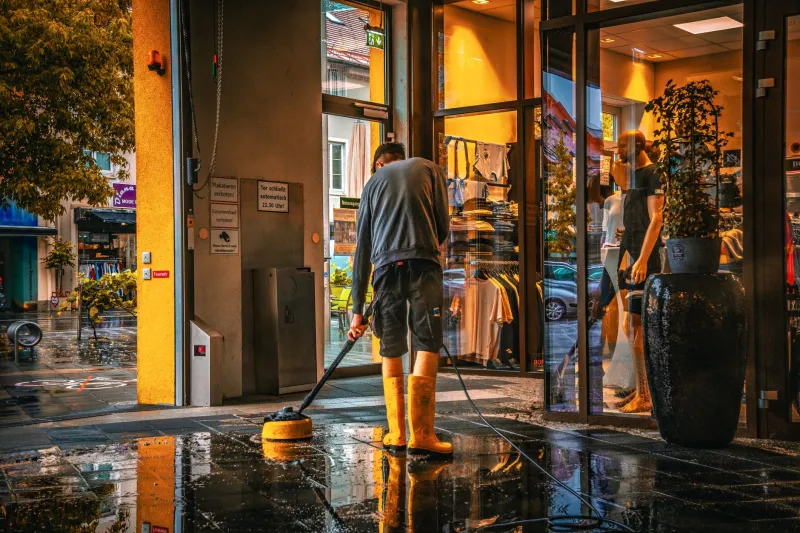
For commercial properties with higher traffic volumes, a microfiber mop system outperforms traditional string mops in two important ways: it reduces the volume of standing water left on the surface, and it is less likely to drag abrasive grit across the coating. Both factors extend the life of the finish layer meaningfully.
Spills warrant immediate attention, particularly anything petroleum-based or highly acidic. While epoxy resists these substances better than most flooring materials, prolonged contact—especially under elevated temperatures—can begin to soften or discolor the surface coating.
Seasonal Humidity Management and What It Means for Your Floor
Tampa's humidity peaks between June and September, which coincides with the heaviest rainfall season. During this period, properties without consistent climate control can experience condensation on slab-level floors—particularly in garages, warehouses, and lower-level commercial spaces.
This condensation does not immediately damage a well-installed epoxy floor, but it creates conditions worth monitoring. Water pooling at expansion joints, near floor drains, or along wall edges can introduce moisture beneath the coating over time if those transition points were not sealed properly at installation. Seasonal inspections—conducted before summer arrives and again in late fall—allow property owners to identify early signs of edge lifting or joint separation before they expand.
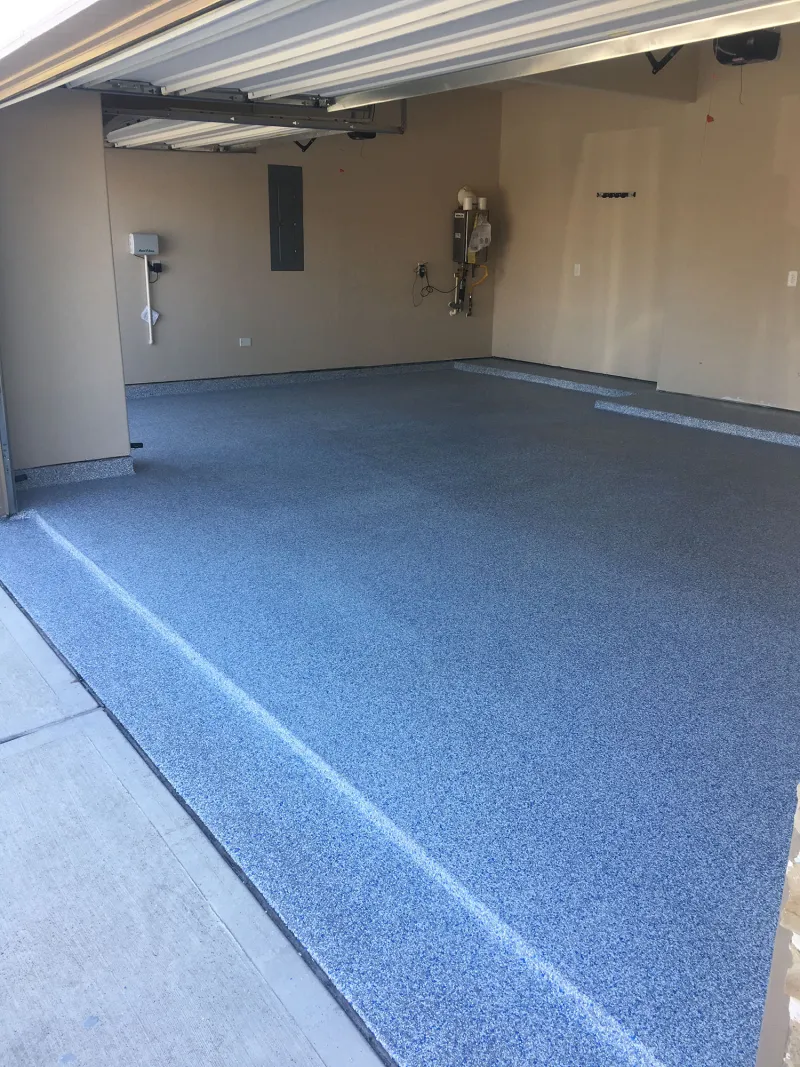
For residential garage floors, a dehumidifier running during peak humidity months provides a straightforward layer of protection. For commercial spaces, ensuring that HVAC systems maintain consistent interior humidity levels—ideally between 40 and 60 percent—reduces the vapor pressure differential that drives moisture migration through the slab.
When Preventive Professional Treatment Makes Financial Sense
Not every maintenance task belongs on an owner's checklist. There is a category of preventive treatment that falls between routine cleaning and full resurfacing—one that professional contractors are positioned to perform and that most property owners are not equipped to handle independently.
Topcoat refreshing, for instance, involves the application of a thin wear-layer coating over the existing surface. It is not a full recoat, and it does not require the extensive surface preparation that a new installation demands. But it does restore surface gloss, fills minor surface abrasions, and re-establishes chemical resistance that has diminished through use. For high-traffic commercial floors, this treatment every three to five years can extend the life of the underlying system by a decade or more.
Joint resealing is another professional-grade service that carries disproportionate value. Control joints and expansion joints in concrete slabs are natural pathways for moisture ingress. Keeping these sealed—and inspecting the condition of that sealant annually—prevents the kind of subsurface moisture accumulation that leads to delamination.
Finally, for any floor installed under a manufacturer or contractor warranty, it is worth reviewing the warranty documentation carefully. Many warranties include specific maintenance requirements, and failure to follow them—even inadvertently—can render the coverage void. Premier Epoxy Tampa recommends that clients retain copies of their warranty terms alongside a simple maintenance log that records cleaning products used and any professional services performed.
Reframing Durability as Partnership
The most accurate way to understand epoxy flooring is not as a maintenance-free surface, but as a low-maintenance surface—one that rewards consistent, informed care with a lifespan that most flooring systems cannot approach.
That distinction matters. A floor that receives the right cleaning protocol, seasonal attention, and occasional professional treatment will perform for fifteen, twenty, or even twenty-five years in Tampa's demanding climate. A floor that is ignored will not meet those benchmarks, regardless of how well it was installed.
At Premier Epoxy Tampa, the installation is only the beginning of the relationship. Property owners who understand that the durability promise is a partnership—not a guarantee that removes their responsibility—are the ones who get the most from their investment. The floor holds up its end. The question is whether the owner holds up theirs.
For guidance on developing a maintenance schedule specific to your floor type and use case, or to schedule a professional inspection of an existing epoxy installation, contact Premier Epoxy Tampa directly. The consultation is straightforward, and the information is worth having before a small issue becomes a significant one.